
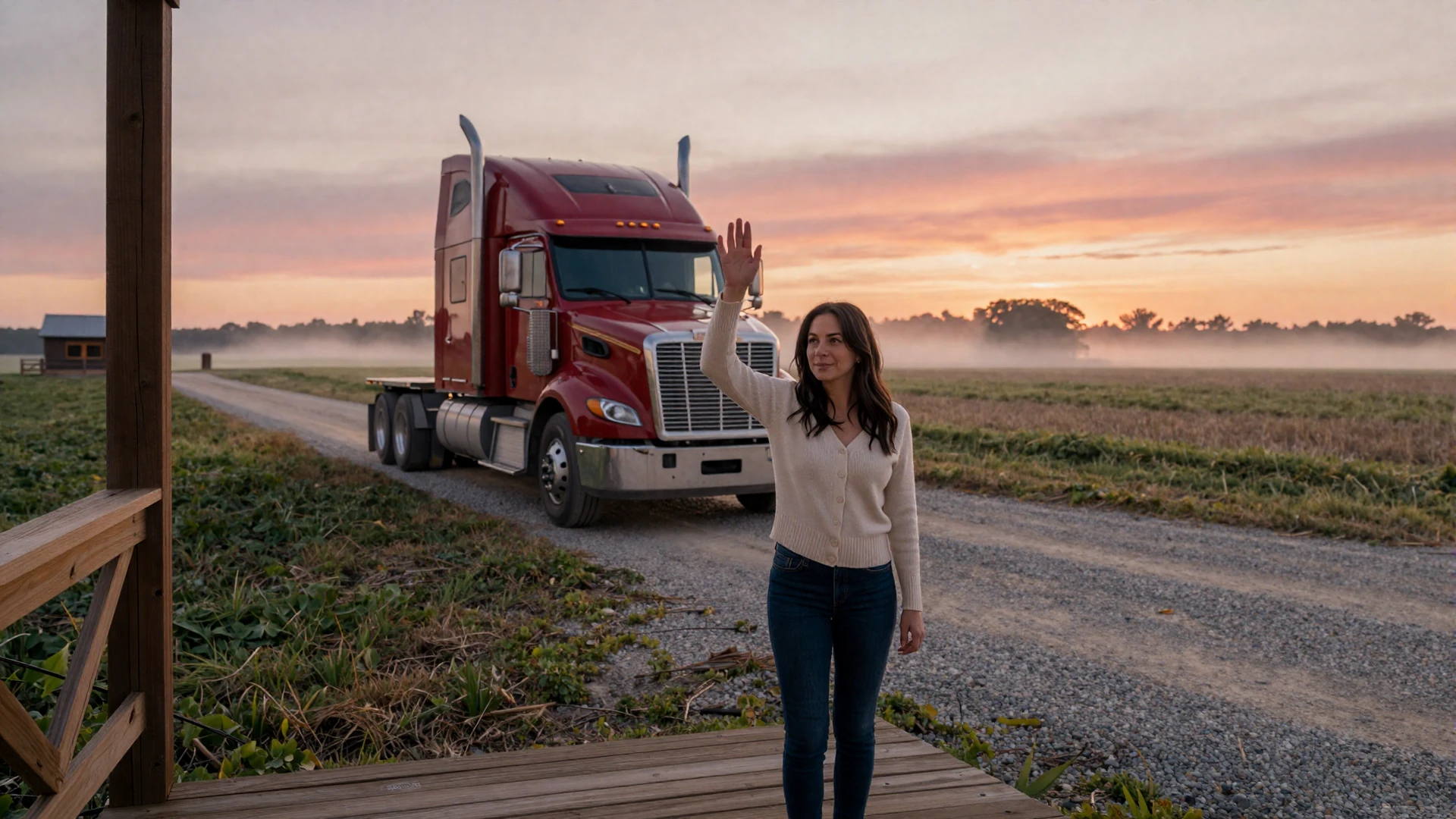
Embrace your independence
The autonomy of life on the road can actually strengthen a relationship through personal growth and mutual respect. Couples who let each other be whole alone become better together.
Two or three weeks apart sounds impossible until you meet the couples who have done it for a decade. This is the playbook real OTR partners use - daily rituals, video-call rhythms, trust habits, and the small gestures that close the miles between you.
Written by the Highway Social editorial team · Informed by Dr. Karin Anderson, Drive My Way, and drivers on I-80, I-40, and I-10
Dating an over-the-road truck driver is one of the few modern relationships where distance is the default, not the exception. He leaves Sunday night. He comes home a couple of Fridays later. In between, you exist in different time zones, different weather systems, and different emotional states - and somehow, you still have to be a couple. The hardest part isn't the goodbye. It's the slow drift that happens when nothing is wrong but nothing is happening either.
Counselors at Dating Across Careers consistently name irregular communication as the number-one destroyer of trucker relationships. Not infidelity. Not money. Just the quiet erosion that happens when two people stop knowing the small details of each other's days. A missed evening call turns into a defensive morning text. A canceled home-time weekend turns into resentment that never gets named. By the time anyone says it out loud, the gap is wider than the windshield.
The good news: every survivable long-distance trucker relationship follows roughly the same blueprint. Daily structure. Predictable rituals. Trust built early and topped up often. Small gestures that prove "I'm still here." This guide walks through that blueprint section by section - the same one couples like Kenn and Beth Zelten (30+ years together on the road) have used since 1989, and the same one new couples on Highway Social use to get through their first three months.
The single most important habit in a long-distance trucker relationship is the daily check-in. It does not need to be long. It does not need to be deep. It needs to be consistent. Couples who succeed almost universally pick a predictable time - 9:00 PM is the most popular among drivers because it lands after parking and before sleep - and they hold it like an appointment, not a suggestion.
The structure that works for most couples runs about ten to fifteen minutes and follows a simple shape:
Save heavier logistics - bills, family scheduling, big decisions - for a separate, shorter daytime call. Mixing emotional and administrative on the same line kills the warmth.
Here's the thing most couples discover by month two: consistency matters more than length. A reliable ten-minute call every night beats an unpredictable two-hour call once a week. The brain settles when it knows the call is coming. The relationship settles with it.
Voice and video are the closest substitutes for being in the same room, and modern couples use them aggressively. The recommended pattern across the industry - echoed by TruckersReport and by drivers in our community - is a scheduled video call after he parks for the night, at least once a week and ideally two or three times.
FaceTime and Skype both work fine. So do WhatsApp and Signal video. The platform matters less than the ritual. Light a candle. Pour a drink. Show him the dog. Make it feel like a date, not a status report.
Between video calls, voice notes do the heavy lifting. They carry tone the way a text never will, they're safe for him to listen to behind the wheel, and they let either of you say something complicated without needing the other to be available in real time. Highway Social was built around this asynchronous rhythm on purpose - long messages, voice replies, photo replies - because it matches how drivers actually live.
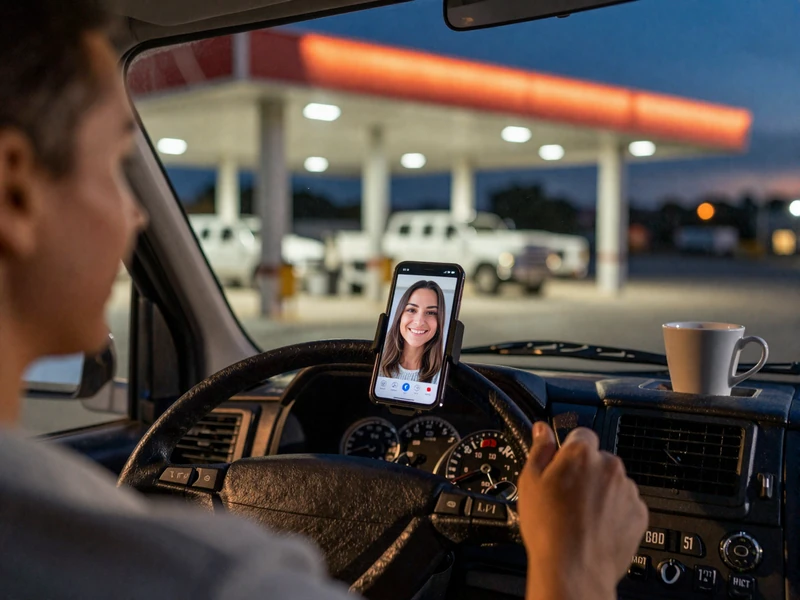
Drive My Way's Alayna Klco frames trust in trucker relationships through one phrase: keeping your eyes on the road. The literal meaning is obvious. The metaphorical one is bigger. Long stretches at truck stops, easy conversations at counters, late nights in unfamiliar towns - none of it has to be a problem. But it can become one if trust hasn't been built first.
Trust isn't something you build after a fight. It's something you build before there's ever a reason to doubt - through transparency, consistency, and the boring everyday work of being where you said you'd be. - What every long-haul couple eventually learns
In practice, transparency looks small and unglamorous. He tells you where he's parking for the night before you ask. You tell him about the dinner with friends before it happens, not after. Location sharing is on by default for both of you - not as surveillance, but as a default setting both partners agreed to early. The point isn't to monitor. The point is to make hiding feel weirder than disclosing.
Insecurity is the silent killer of long-distance relationships, and it grows in the gaps where information should live. Fill the gaps preemptively. Mention the dispatcher who was friendly. Mention the waitress who remembered his order. Boring transparency starves jealousy before it can form.
In long-distance relationships, the smallest gestures often carry the most weight - a shared joke, a remembered detail, a plan for next month. These are the threads that weave the fabric of a real partnership. For trucker couples, love isn't only about being together. It's about staying emotionally and spiritually connected across the miles between you.
What this looks like in practice is almost embarrassingly simple. A photo of his sunrise out of Salina, Kansas. A voice note that says nothing important. A care package mailed to a planned truck stop with his favorite gum and a handwritten note. A list of things you love about him taped to the sun visor on his last home-time day. None of these require effort. All of them require attention.
The couples who last almost universally have at least one small ritual they have repeated for years. Brook and Jonny send each other a sunrise or sunset photo every single day. Vi and Lee sign off every voice note with "miles to you." The phrase doesn't matter. The fact that it happens every day, without exception, does.
Here's why it matters: distance erodes connection by accident, not on purpose. The remedy isn't grand gestures. It's the steady drip of I am still here, I am still thinking of you, I noticed something today and you were the first person I wanted to tell. Repeated for months. Repeated for years.
Relationship researcher Dr. Karin Anderson studies couples in non-traditional schedules - military, medical, and trucking. Her framework distills cleanly into five rules trucker couples can adopt this week.
The autonomy of life on the road can actually strengthen a relationship through personal growth and mutual respect. Couples who let each other be whole alone become better together.
Regular check-ins at a set time outperform spontaneous marathon calls. Pick a window. Hold it. Treat it as the most important meeting on either of your calendars.
Words of affirmation, quality time, acts of service, gifts, physical touch. Learn which one matters most to your partner - and which matters most to you - and translate it for the road.
A photo from a strange truck stop. A note left in his bag before he rolls out. A detail of your day shared without being asked. These are the threads. They hold.
Quality over quantity. One protected anchor activity per home-time window - a real date night, a slow morning, a quiet drive - beats a packed weekend he's too tired to enjoy.
Don't wait for the relationship to be in trouble to start any of these. Build the structure when things are good. The structure is what keeps things good.
Jake is a long-haul driver with fifteen years on the road. Emma is an elementary-school teacher who has never sat in the passenger seat for more than a weekend run. By every conventional metric, their schedules should not have worked. They have been married for over a decade.
Their formula, documented by Dating Across Careers, is almost boring in its simplicity. They lean on technology aggressively - daily voice notes, a scheduled FaceTime every Wednesday night, a shared Google Calendar that color-codes his loads and her parent-teacher conferences so neither one is ever surprised. And before every home-time window, Emma plans one specific activity she has been looking forward to for weeks. A new restaurant. A hike. A movie night with takeout. Something that makes the return feel like a second honeymoon instead of a re-entry.
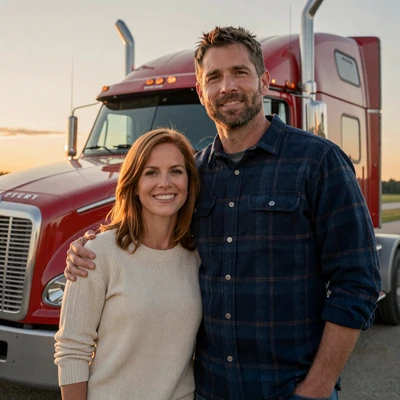
We figured out early that distance is just a logistics problem. Connection is the actual work. Every time I park for the night, she's the first call. Every time I come home, she's already planned something I didn't know I needed.
There are dozens of versions of Jake and Emma in our community. Drivers and teachers. Drivers and nurses. Drivers and dispatchers. Drivers and women who simply understood the schedule from day one. The route varies. The job titles vary. The blueprint does not.
OTR vs regional vs local - and how each one reshapes the relationship from week one.
The daily check-in structure, re-entry adjustments, and small gestures that survive a 21-day run.
HOS rules in plain English: the 11-hour limit, 34-hour reset, and planning home time like a couple, not a dispatcher.