Route-Based Matching
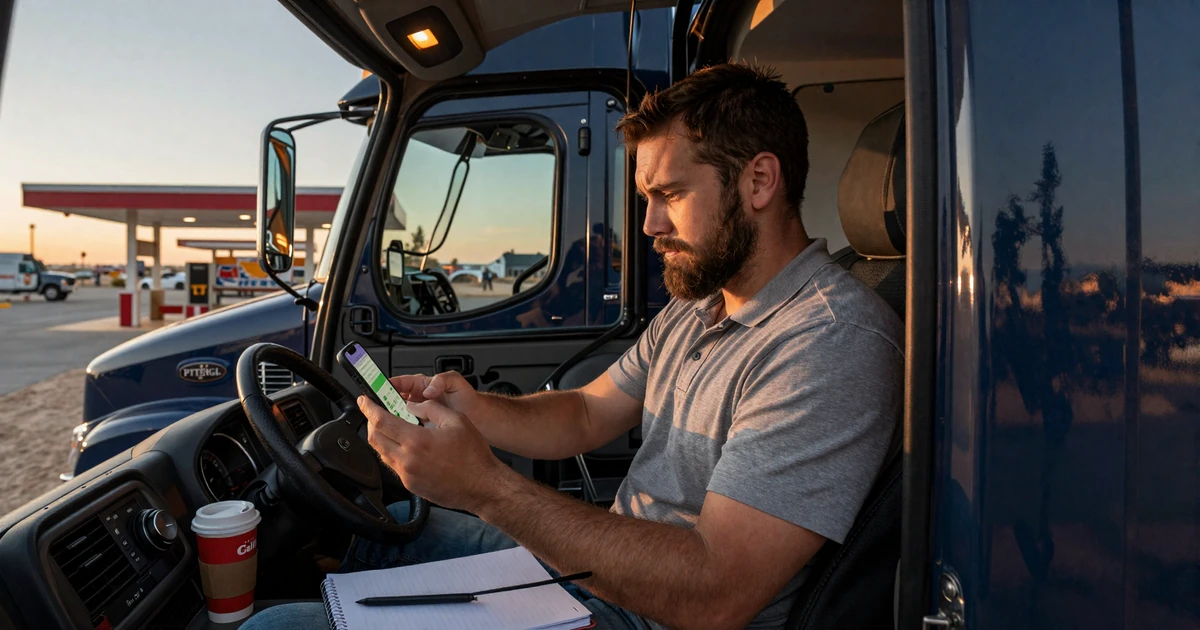
Enter your regular lanes and upcoming runs. The platform surfaces compatible women along those corridors instead of pinning you to a static home city you barely see.
Mainstream dating apps were built around a single assumption - that both users can grab coffee this weekend. For a long-haul driver 800 miles from home with a 2-week reset ahead, that assumption breaks the entire product. Here is what actually goes wrong, in numbers.
Highway Social editorial · Data: SwipeStats (294M swipes, 7,000+ profiles), Business of Apps 2025, Lovezoid 2026
The explanation problem is the moment, usually inside the first three messages, when an OTR driver has to justify his entire lifestyle to a stranger who has never met anyone who does this job. "I'm a truck driver." "How long are you gone?" "Two to three weeks." "Oh." The thread cools off. Another match buried.
This is not a failure of charm. It is a structural mismatch between how Tinder, Bumble, and Hinge are designed and how trucking actually works. Mainstream platforms reward fast, local, weekend-available users. Drivers running freight from Dallas to Laredo or holding down an I-80 cross-country lane are none of those things. They get penalized for telling the truth.
"Swipe fatigue is redefining the dating app industry. Users want a better experience that leads to real connection - not endless swipes." Average session time has already dropped from 13.21 minutes (2024) to 11.49 minutes (2025). - PURE CEO, via Business of Apps 2025
Here's the catch: 42% of US adults now say online dating is a good way to find a long-term partner, and 52% of Gen Z use apps specifically for serious relationships. The intent is there. The product just doesn't fit a driver's reality. Tinder's uninstall rate sits at 62.4% for paid acquisition and 57.8% for organic - a quiet signal that the swipe model is leaking users at scale.
Mainstream apps don't just fail drivers passively - they actively downrank profiles that respond slowly or can't meet locally. The math is brutal.
Average Tinder match rate for men across 7,000+ profiles. The median is even lower at 2.04%.
Source: SwipeStats analysis of 294M swipes, 2025
How much more often women receive matches than men on Tinder - the asymmetry that drives male migration to niche platforms.
Source: SwipeStats, 2025
Match conversion rate for men who swipe right on Tinder, despite 46% of male right-swipes signaling genuine interest.
Source: SwipeStats, 2026
The Tinder algorithm rewards two behaviors: fast replies and quick meetups. Both are structurally impossible for an OTR driver. When a match messages you at 8 PM and you answer 11 hours later from a fuel island in New Mexico, the system reads it as low engagement and reduces how often your profile gets shown. Two delayed replies in a week and you're effectively shadow-banned to the bottom of the deck.
Men also use the apps harder and get less out of them. SwipeStats clocked men opening Tinder an average of 5,646 times versus 3,779 for women - 49% more sessions producing 8× fewer matches. That's not a personal problem. That's a product designed for the other side of the marketplace.
Mainstream apps assume you live in one place and meet people who also live in that place. Tinder uses your current GPS coordinates and a fixed radius. Bumble and Hinge use a chosen "city of residence." None of them know what a freight lane is.
For a driver, this produces absurd outcomes. Pull into a Pilot in Albuquerque and the algorithm shows you women who live in Albuquerque - none of whom care that you'll be gone in 9 hours. Set your home base to Dallas and you only see Dallas matches, even though you spend 70% of your year on I-10, I-20, and I-35 corridors that pass through dozens of cities full of women you could realistically meet.
Route-Match technology, pioneered by TruckDriverDating.site and now adopted by RoadHeart and Highway Social's Shared Destination Matching, flips the model. The driver enters his regular freight lanes - Dallas to Laredo, I-80 cross-country, the I-95 East Coast run - and the platform surfaces compatible partners along those corridors. Abstract "long-distance" becomes concrete: coffee at a specific truck stop on a specific Thursday.
Every mainstream app has more men than women. On Tinder, the ratio is so skewed it explains most male frustration without anyone needing to mention trucking at all.
Verified male-to-female user ratio on Tinder per SwipeStats. External estimates push it closer to 76/24.
Source: SwipeStats profile audit, 2025
Bumble male-to-female ratio - the most balanced of the major mainstream platforms, but still tilted.
Source: SwipeStats, 2025
Hinge male-to-female ratio. Better than Tinder but the math still works against male drivers in the visibility deck.
Source: SwipeStats, 2025
Here's what the imbalance means in practice: every woman on Tinder receives roughly 9× the inbound interest of every man. She can be picky. She can ignore profiles that don't immediately fit her weekend availability. A trucker profile with photos from four states and a "home in two weeks" line is exactly the kind of profile that gets a polite swipe-left in that environment.
Niche platforms invert this dynamic because the women who join them are pre-selected for interest in the trucking lifestyle. They aren't comparing your "I'm OTR" line to 200 nine-to-five resumes. They came specifically to meet someone who runs the road.
The structural problems above all have the same root cause: a one-size-fits-all product. Niche platforms like Highway Social start from a different assumption - that the road is part of the relationship, not an obstacle to one.
Enter your regular lanes and upcoming runs. The platform surfaces compatible women along those corridors instead of pinning you to a static home city you barely see.
Voice notes, asynchronous chat, and reply windows built for truck-stop Wi-Fi. A 14-hour reply gap signals real life - not low engagement that buries your profile.
Profiles are vetted for the lifestyle, not just identity. Women who join Highway Social already understand HOS rules, home time, and the 34-hour reset. No explanation required.
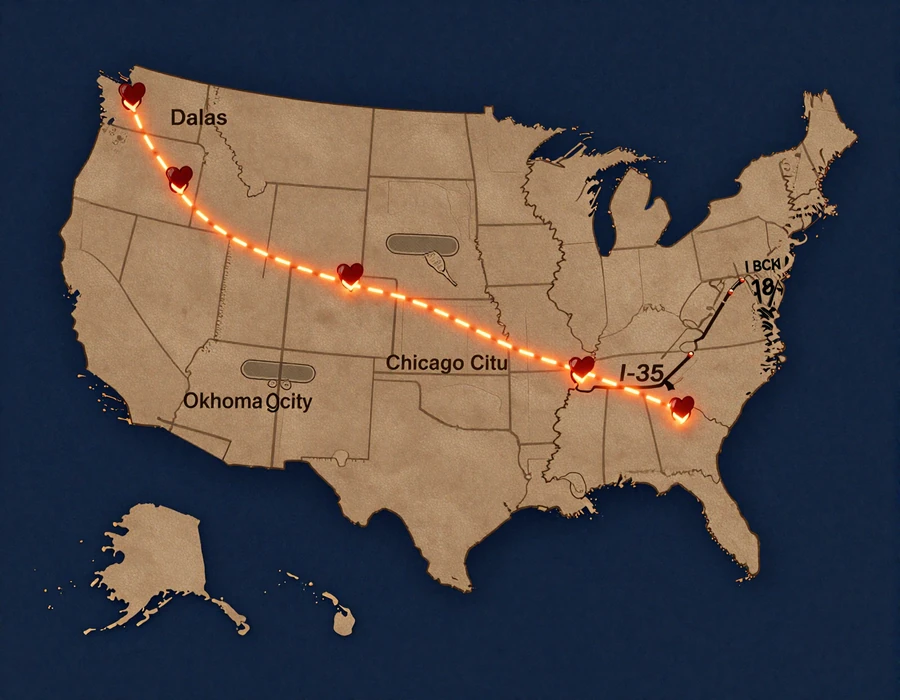
The biggest signal that a niche platform works isn't its feature list - it's whether real couples have come out of it. Highway Social's Love Stories Map pins every reported couple on a US map, with route notes and timeline details. As industry analysts noted in 2026: "Legit sites have Success Stories and real reviews. If a site feels like a community rather than a marketplace, it is likely the real deal."
For a deeper comparison of trucker-specific platforms, see our roundup of the best dating apps for CDL drivers. For tactical advice on writing a profile that actually converts, read our online dating tips for truck drivers.
The 333 rule is a 2025-2026 dating-app guideline that suggests matching with no more than 3 people at once, exchanging at most 3 messages before suggesting a call, and meeting within 3 weeks. The goal is to counter swipe fatigue and force intentional choices instead of endless parallel conversations. For truck drivers, the rule is hard to apply on mainstream platforms because the 3-week timeline rarely fits a freight schedule - which is exactly why niche platforms with route-aware matching work better.
The best dating site for truck drivers in 2026 is a niche platform that combines route-based matching, schedule-aware messaging, and a verified community of women interested in the trucking lifestyle. Highway Social fits all three criteria, alongside competitors like TruckDriverDating.site and RoadHeart. Mainstream apps (Tinder, Bumble, Hinge) consistently rank lowest because their algorithms penalize the slow reply times and 2-week home windows that are normal for OTR drivers.
Three structural reasons: (1) the male match rate sits at 5.26% on average and 0.6% for men who swipe right, (2) Tinder uses your current GPS instead of route data, so it shows you women in cities you'll leave in 9 hours, and (3) the algorithm downranks profiles that reply slowly - and an OTR driver replies on a fuel-stop schedule, not a weekend-brunch schedule.
Yes - and the share of active female profiles is the single metric to check before paying for any platform. Highway Social publishes route-based active user counts by state. Legitimate niche sites also display Success Stories with names, locations, and timelines that can be cross-verified. Avoid any platform that requires a credit card before letting you see profiles - that pattern was the main complaint that sank DateTruckers' reputation in 2024-2025.
For most full-time OTR drivers, yes. The 5.26% average match rate and the algorithmic burial of slow responders mean that effort spent on Tinder produces almost no return. The same hour invested on a niche platform with route-based matching and a community that already understands the lifestyle produces measurably more first dates. Try both for 30 days if you're unsure - most drivers don't go back.